Madan Lal Dhingra

The London Files — Contents

Home / File 07

File 07 · Memory · 1909 to the present

After 1909

A man executed at twenty-five, disowned by his own family, has been remembered for over a century — in bronze, on a postage stamp, and in a wreath laid every August in Amritsar. What is being remembered has changed several times.

01

How he is remembered

Four objects from the present, each with its wall label.

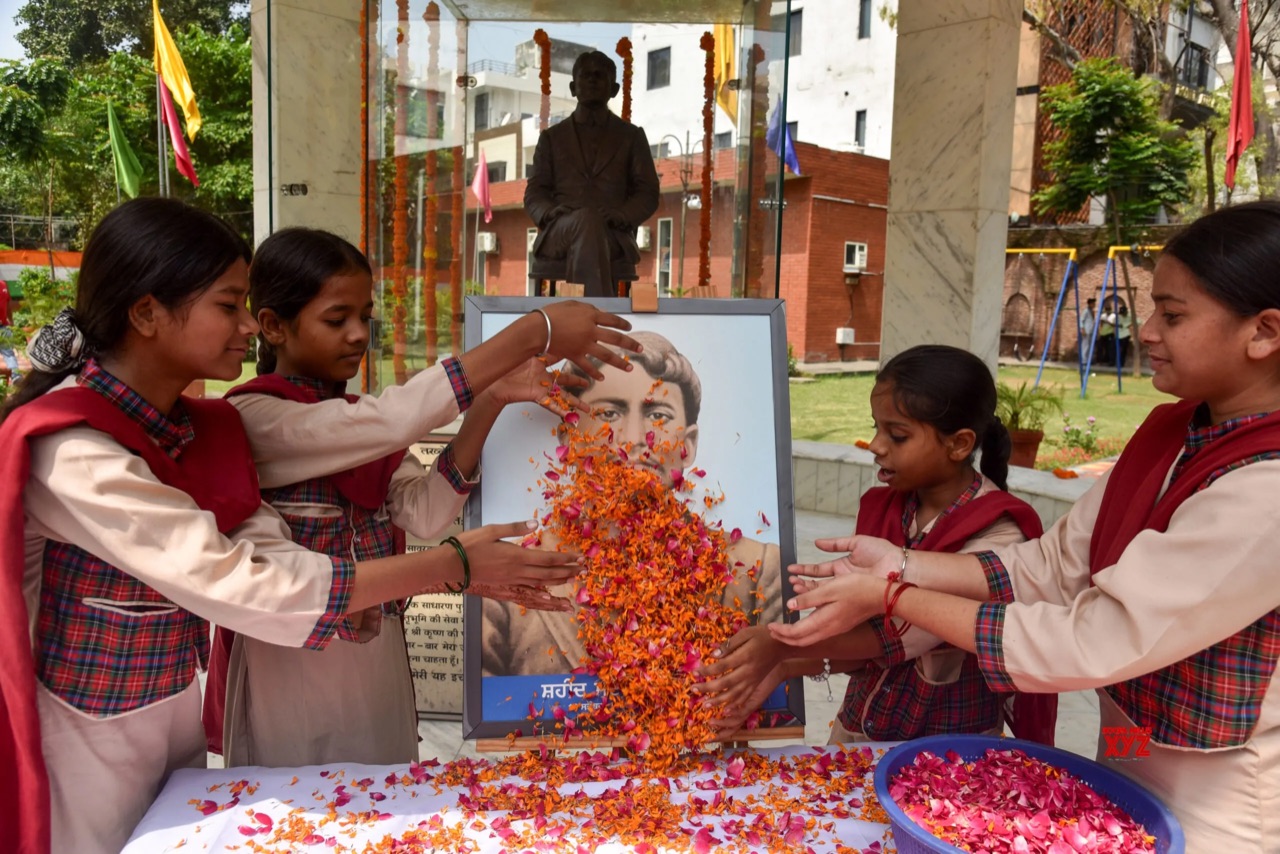
Four schoolgirls in uniform scatter marigold and rose petals over a framed portrait of Madan Lal Dhingra at an outdoor memorial; behind the frame, a bronze seated statue of him stands inside a glass pavilion hung with flower garlands.
Object 01 · Amritsar · annual observance

Petals, every August

School students scatter petals over his portrait at the memorial in Amritsar. Behind them, inside a glass pavilion, is the seated bronze figure; the plinth carries text in Punjabi and Hindi.

This is the form his memory mostly takes now: a civic ritual, performed by children who were taught about him at school, on the anniversary of his execution. It is worth noticing what such a ritual does. It fixes a complicated twenty-five-year-old as a settled example.

Photograph credit: SocialNews.XYZ, whose watermark appears in the source image. Reproduced uncropped.
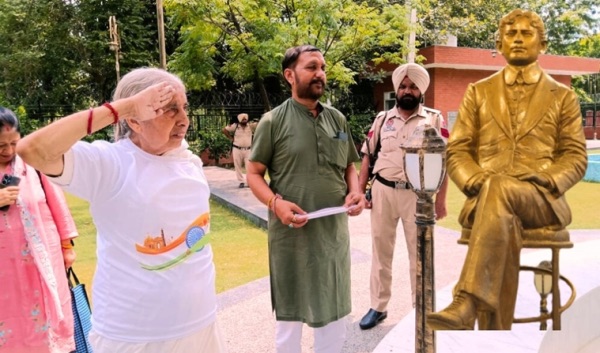
A gilded statue of Madan Lal Dhingra seated in a chair stands in a memorial park in Amritsar; visitors and a uniformed police officer stand nearby, one of them saluting.
Object 02 · The memorial park

The seated figure

The statue takes its pose directly from the surviving photograph: the same chair, the same folded hands, the same suit. A sculpture made from a snapshot, then gilded and set in a park.

Almost every three-dimensional representation of Dhingra is a translation of that one image. The memorial is not a likeness taken from life; it is a likeness taken from a photograph of a young man who sat for a picture in a garden.

Contemporary photograph at the Amritsar memorial. Individuals present are not identified by this archive.
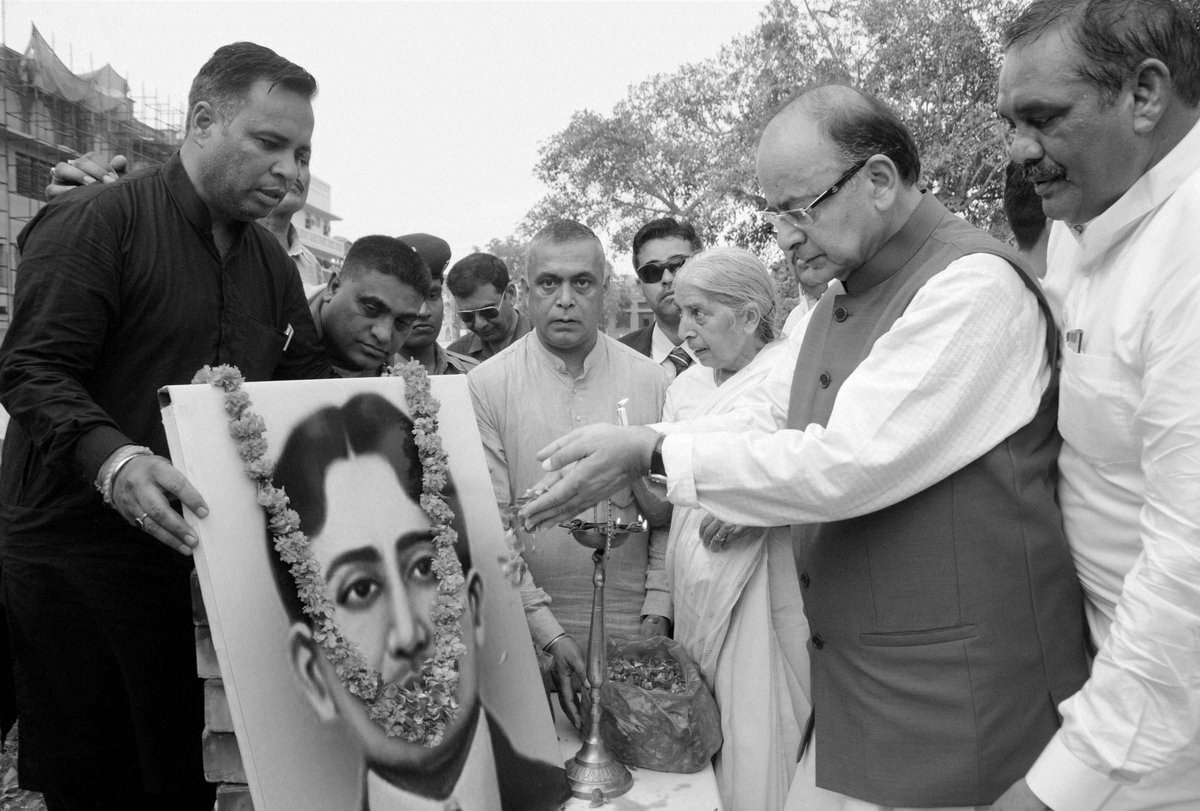
A black and white photograph of a commemorative ceremony: a group of people stand around a garlanded framed portrait of Madan Lal Dhingra while one of them lights a tall brass lamp.
Object 03 · Official commemoration

A lamp lit before a portrait

Commemoration of Dhingra is not only local and civic; it is also political. Ceremonies of this kind are attended by public figures, reported in the press, and used to make arguments in the present about courage, sacrifice and national memory.

That is neither surprising nor illegitimate. It is, however, worth registering: what happens at these events is the making of meaning, not the recovery of evidence.

Contemporary photograph of a commemorative ceremony. Individuals present are not identified by this archive.
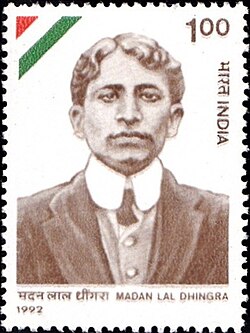
A 1992 Indian postage stamp of one rupee showing an engraved portrait of Madan Lal Dhingra in sepia, with his name printed in Devanagari and Latin script and the year 1992.
Object 04 · India Post · 1992

One rupee

In 1992 the Government of India issued a commemorative postage stamp bearing his portrait — again engraved from the same photograph. The name appears in Devanagari and in Latin script; the denomination is one rupee.

A state stamp is the most formal kind of remembering there is. Eighty-three years after a British court hanged him and his own family disowned him, the Indian state put his face in the post.

Verified: commemorative stamp issued by India Post, 1992.
02

The man, the symbol, the myth

Three different objects that share a name. Confusing them is how most bad history about Dhingra gets written.

01 The man

A civil surgeon's son from Amritsar who left college after a dispute, worked as a clerk and a labourer, studied mechanical engineering in London, moved in a small circle of revolutionary nationalists, killed two men in July 1909 and was hanged in August at twenty-five.

The documentary record of his inner life is close to empty. We do not have his letters, his reading, his arguments with friends, or any account of him written before he became notorious. The man is mostly a gap.

02 The symbol

Within weeks of the execution he had become a figure in an argument: proof, for revolutionaries, that Indians would act; proof, for Gandhi and the constitutionalists, that the revolutionary method was both wrong and counter-productive; proof, for the British administration, that Indian students required watching.

After independence the symbol was absorbed into the national story of the freedom struggle — a martyr among martyrs, in textbooks and on a stamp.

03 The myth

The myth is what fills the gap the man left: invented childhood scenes, unsourced quotations, a Churchill endorsement no one can locate, and a clean causal story in which one insult produces one gunshot.

Myth is not the same as lying. It is what a society does with a figure it needs. But it should be labelled, and a historical archive is exactly the place to label it.

03

Common claims, and their status

Claim What is saidWinston Churchill called his final words the finest ever made in the name of patriotism. StatusUnverified. Appears in later secondary accounts, usually hedged with “it is said”. No contemporary source identified here.
Claim What is saidSavarkar directed the assassination. StatusContested. Asserted in many accounts and denied in others. No charge was brought against him in connection with it. Dhingra told the court he acted on his own responsibility.
Claim What is saidHe was expelled from Government College, Lahore in 1904 for leading a protest against a blazer made of imported British cloth. StatusWidely recounted in published biographies and reference works. Not verified here against a contemporary source.
Claim What is saidHe was 26 when he died. StatusCommonly stated, and slightly wrong. Born 18 September 1883, executed 17 August 1909: he was 25, a month short of 26.
Claim What is saidHis ashes rest at a memorial in Akola, Maharashtra. StatusReported, and inconsistently. The repatriation of his remains on 13 December 1976 is well attested; what happened to them afterwards is described differently across sources.
Claim What is saidHe was the first Indian revolutionary to strike on British soil. StatusCommonly described this way, and defensible — but it is a claim about firsts, which depends entirely on how the category is drawn. Treat it as shorthand rather than as a finding.
04

How history should hold him

Two propositions can be held at once, and a serious account has to hold both.

The first: British rule in India was a system of foreign domination that used force, suspended legal process when challenged, and gave Indians no lawful route to govern themselves. Dhingra's description of his own position was not a fantasy. It was an accurate reading of the constitutional situation he was in.

The second: he shot two men, and one of them — Dr Cawas Lalcaca — was a doctor doing what doctors do. No account of colonial injustice removes that. The Indian national movement itself, in its overwhelming majority, reached the same conclusion at the time and built its successful strategy on the opposite method.

Understanding him means being able to say both without needing to cancel one with the other. That is what this archive has tried to do.

Next — the archive