Home / File 01
File 01 · Amritsar · 1883–1906
Before London
Twenty-three years in Punjab, of which the surviving record is thin, uneven and mostly written after 1909 by people who already knew how the story ended.
A civil surgeon’s son
Madan Lal Dhingra was born on 18 September 1883 in Amritsar, in the Punjab, into an educated and prosperous Hindu Khatri family. His father, Dr Ditta Mal Dhingra, held the post of civil surgeon — a senior appointment within the colonial medical service, carrying salary, status and an official relationship with the British administration of the province.
He was one of eight children: seven sons and a daughter. All seven sons were sent abroad to study, which in the Punjab of the 1890s placed the family in a very small and very confident class. The household was English-speaking, professionally successful, and by every account loyal to the government that employed its head.
This matters for two reasons. First, because it removes the easy explanation: Dhingra did not come to anti-colonial politics through poverty or exclusion. He came to it from inside the class the Raj had cultivated most carefully. Second, because it explains the sharpness of what followed. When he was arrested in 1909, his father and his brothers publicly disowned him — a repudiation printed in the newspapers, which cost the family its social position all the same.
Beyond these outlines, the childhood record is genuinely poor. Later accounts supply scenes, conversations and formative slights; almost none of it can be traced to a source written before 1909. This archive leaves those gaps open.
The family register
- Born
- 18 September 1883, Amritsar, Punjab, British India
- Father
- Dr Ditta Mal Dhingra, civil surgeon in the colonial medical service at Amritsar
- Household
- Hindu Punjabi Khatri family; eight children — seven sons and one daughter
- Brothers
- All seven sons of the household were educated abroad. One elder brother, a doctor, was living in England and is described in several accounts as encouraging Madan Lal's passage to Britain.
- After 1909
- The family publicly disowned him following the assassination. Contemporary press reports carried the disavowal.
- Photographs
- No family photograph of the Dhingra household is held in this archive. None has been reconstructed or invented to fill the space.
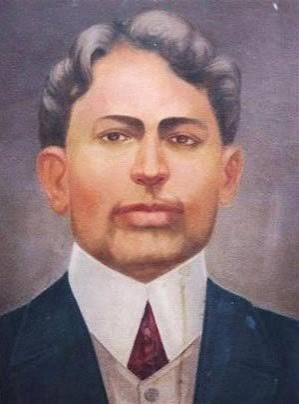
A colour painting worked up from the surviving photograph, of the kind produced for Indian memorial halls and school textbooks. It is a later commemorative artwork, not a portrait made from life.
There is no known photograph of Dhingra as a child, and none from his years in Punjab. Every image on this page postdates 1909.
An education built for service
Dhingra was schooled in Amritsar and then in Lahore, the administrative and intellectual capital of the province. He attended MB Intermediate College in Amritsar until about 1900, and afterwards Government College, Lahore — the most prestigious institution in northern India and, by design, a training ground for the men who would staff the colonial administration.
The colonial education system in Punjab had a clear purpose. It produced clerks, engineers, lawyers, doctors and administrators who could operate the machinery of the Raj in English, and who could be relied upon to identify their own prospects with its continuation. It worked, for the most part. It also produced, in every generation, a minority who took the political vocabulary they were taught — liberty, representation, the rule of law, the rights of the subject — and turned it back on the government teaching it.
-
Amritsar — MB Intermediate College, to about 1900
Secondary and intermediate education in his home city. Nothing in the surviving record singles out these years as politically formative.
-
Lahore — Government College
The Punjab's flagship college, and the point at which Dhingra entered a wider political environment. Lahore in the early 1900s was a centre of Arya Samaj reform, of the Punjabi press, and of the agitation that would erupt in 1907 over land-revenue and colonisation legislation.
-
1904 — the break
He left Government College after a confrontation with the college authorities. The incident is set out in the next section, together with a note on how reliable the account is.
The blazer, 1904
The episode most often told about Dhingra's youth concerns cloth. According to the standard biographical accounts, in 1904 the principal of Government College ordered that the college blazer be made from cloth imported from Britain. Dhingra led a student protest against the order, refused to apologise for it, and was expelled.
If the account is accurate, the timing is significant. The Swadeshi movement — the campaign to boycott British manufactures and use Indian-made goods — became a mass phenomenon after the partition of Bengal in 1905, but the argument about imported cloth was already circulating in Indian nationalist writing before then. A dispute over a college jacket was, in that context, a dispute about whether Indian institutions should be furnished by Indian industry.
It would be neat to treat this as the moment of political awakening. It should not be. The episode appears in later biographies rather than in any contemporary document available to this archive, and it has been retold many times in a form that flatters the ending. What can be said is that by 1904 Dhingra had left the college, and that he did not return to formal education in India.
Swadeshi — literally “of one's own country” — combined the boycott of British goods with the promotion of Indian manufacture. It turned ordinary consumption into a political act, and made objects like cloth, matches and sugar into arguments about empire.
Three years after Dhingra left Lahore, the Punjab erupted over the Colonisation Bill and canal water rates. Lala Lajpat Rai and Sardar Ajit Singh were deported without trial in 1907. The province Dhingra had grown up in was, by the time he reached London, in open political conflict.
Dhingra was an unremarkable private individual until July 1909. Nobody was collecting his letters, and his family destroyed or withheld what they had after disowning him. Almost everything written about his early life was written backwards, from the assassination.
Work, 1904–1906
The least discussed period of his life, and arguably the most revealing.
A clerk at Kalka
He worked as a clerk for a tonga firm at Kalka, in the foothills below Simla — a transport business serving the summer traffic to the hill capital. It was routine employment far below what his education and family standing would ordinarily have secured.
Factory labour
He also took work as a labourer in a factory, and according to the biographical accounts attempted to organise the workers there. Whatever the detail, the direction is clear enough: for two years the son of a civil surgeon lived and worked outside the professional class he had been raised in.
Bombay
Several accounts place him in Bombay in this period, in a succession of low-paid jobs. Bombay was then the commercial capital of British India and one of the centres of nationalist journalism and organisation.
These years are recorded in summary form in the biographical literature and are difficult to verify in detail. What they establish is not a specific event but a pattern: a deliberate step out of the career the colonial system had prepared for him, two years before he stepped back into it by sailing for London.
Why engineering, why Britain
In 1906 Dhingra sailed for England and enrolled to study mechanical engineering at University College London. Several accounts credit an elder brother, then in Britain, with urging and helping to fund the move; the family's means and its habit of sending sons abroad make the passage unremarkable in itself.
Engineering was a deliberate choice for Indian students of that generation. Law and medicine led into the professions and the courts; engineering led into industry, railways and public works — the physical apparatus of the colonial economy, and, in nationalist argument, the skills India would need to build an economy of its own. Choosing to study machinery in Britain was, for many Indian students, an economic argument as much as a career.
What the choice also did was place him inside a specific social world. An Indian student in London in 1906 was legally a British subject, formally entitled to the same treatment as any other, and in daily practice something else — watched by the India Office, discussed in Parliament, and conscious of it.
He arrived roughly a year after a house had opened in Highgate for exactly such students. What that house was, and what it argued, is File 03.